
30 September 2026 • Friday of Trinity 17 • Luke 13:1–5
Bad news has a way of always getting to the church first. Somebody hears it in the parking lot, and by the time the bell rings, everybody knows.
That is how our Gospel begins. People have been talking. The news has spread, and now some people come to Jesus with that news, maybe the pastor’s last to know. Pilate, the Roman governor, has killed a group of Galileans. And not out in the country somewhere. In the temple. They had walked all the way down from Galilee to Jerusalem, because the temple was the one place on earth where God said a sacrifice could be offered. They brought their offerings to His altar. And Pilate had them cut down right there, so that the blood of the men ran together with the blood of the animals. “Whose blood Pilate had mingled with their sacrifices” (Luke 13:1). That certainly is bad news.
Think about who died. Not the careless. Not the ones who stayed home. These Galileans, believers, died at worship, with their offerings in their hands.
And think about the people who brought the news. They were not asking Jesus where God was. They already had their answer. Something must have been wrong with those Galileans. God must have had His reasons. Or, as you hear it today, God always has a plan. What kind of plan was it for those Galileans? And the part they did not say out loud: it didn’t happen to us, so we must be all right.
Jesus hears the question under the question, and He answers it. “Do you suppose that these Galileans were worse sinners than all other Galileans, because they suffered such things? I tell you, no” (Luke 13:2–3).
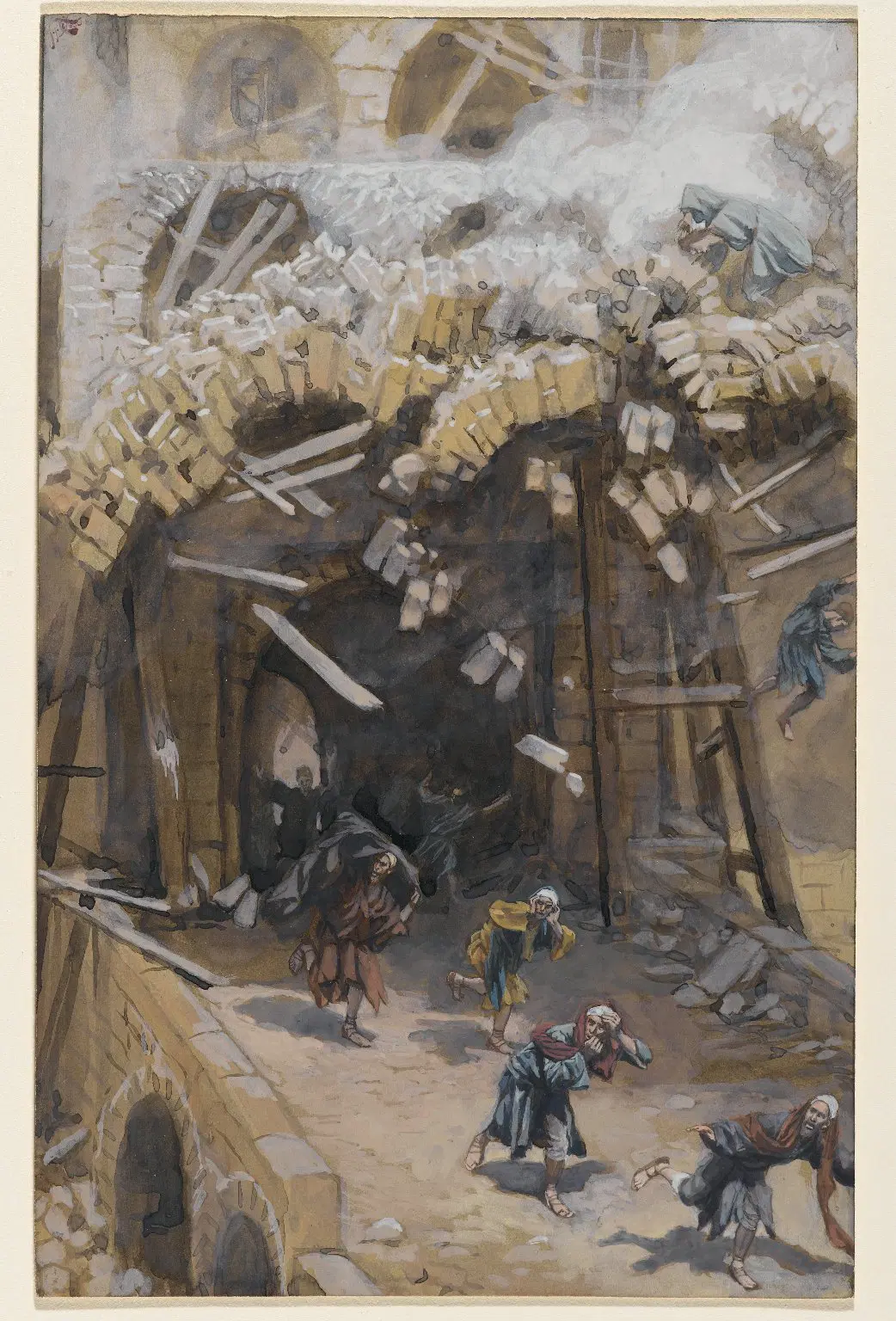
Then He adds a second story they did not ask for. Eighteen men in Jerusalem, killed when a tower came down on top of them at Siloam, at the south end of the city, by the same pool where Jesus sent a blind man to wash. No Pilate this time. No soldiers. No villain at all. Just stone, and a bad day, and eighteen funerals. “Do you think that they were worse sinners than all other men who dwelt in Jerusalem? I tell you, no” (Luke 13:4–5).
So Jesus takes away both our explanations. Wicked men with swords. Falling towers with no one to blame. Neither tells you who is right with God. And twice, word for word, He says the thing nobody came to hear. “Unless you repent you will all likewise perish” (Luke 13:3, 5).
We know how this goes, because we do it too. A man loses the farm, and we wonder what he did wrong with the money. A marriage comes apart, and we are quietly sure we would have handled it better. Somebody gets the diagnosis at fifty-eight, and we tell ourselves he never did take care of himself. We read the obituaries. We hear the news at the church door. And every time, without meaning to, we sort the dead. We look for the reason it was them. We look to cast blame.
Because if we can find the reason, we can stay out of its way. Maybe we can learn from the example. That is the wisdom of this world. Those who don’t know history are doomed to repeat it. St. Paul says “Jews request a sign, and Greeks seek after wisdom” (1 Corinthians 1:22). We want both. We want an explanation, and we want a sign that God is on our side. And the few of us who come out on a Wednesday night are not above it. The Galileans came to worship too.
Jesus will not give the sign. He will not give the explanation. He gives the Law at full strength. We are no better than the ones under the rubble of the tower. We are no better than the ones slain before the altar by Pilate. Unless we repent, we will likewise perish.
But Jesus does not leave the story there. And actually, neither does Pontius Pilate.
A few chapters later, Jesus Himself comes to Jerusalem at Passover, with the city full of lambs. He is arrested, and He is brought before the same Pilate. And St. Luke records one small detail. When Pilate heard where the prisoner was from, “he asked if the Man were a Galilean” (Luke 23:6).
Same Gospel. Another Galilean. Another feast. Another sacrifice. The same governor.
Pilate sends Him to Herod, and Herod sends Him back. “That very day Pilate and Herod became friends with each other” (Luke 23:12). The church knew the psalm we prayed tonight: “The kings of the earth set themselves, and the rulers take counsel together, against the LORD and against His Anointed” (Psalm 2:2). Pilate and Herod. And when the church in Jerusalem prayed that psalm, they named names: “both Herod and Pontius Pilate” (Acts 4:27).
Here is what the people with the news could never have guessed. At the temple, Pilate mingled the blood of men with the blood of their sacrifices. At the cross, there is nothing left to mingle. The blood of this Man is the sacrifice. The Galilean is the Lamb. He suffers outside the gate, “that He might sanctify the people with His own blood” (Hebrews 13:12).
That is the only sign God gives. The Jews seek after signs, and the sign is Christ crucified. “We preach Christ crucified, to the Jews a stumbling block and to the Greeks foolishness” (1 Corinthians 1:23). The world looked at that cross and saw one more Galilean Pilate had killed. God looked at it and saw the end of His wrath against you.
Look at who seems strong on that Friday. Pilate has the soldiers. Pilate has the nails and the hammers and the sign over the cross. The Galilean has nothing. They make another man carry His cross. And St. Paul says that is exactly where God’s strength is. In weakness. “The foolishness of God is wiser than men, and the weakness of God is stronger than men” (1 Corinthians 1:25). Pilate’s power could cut down Galileans at the altar. It could not keep one Galilean in the grave. “The message of the cross is foolishness to those who are perishing, but to us who are being saved it is the power of God” (1 Corinthians 1:18). There’s that word again. Perishing. Jesus did not come to explain the perishing. He came to stop it.
Do you want to know what God thinks of sin? Don’t look at the tower that fell on those eighteen men. Look at the cross. There His judgment fell, full weight, on the one Man who did not deserve it. Do you want to know what God thinks of you? Look at the cross again. That judgment fell on Him, so it would not fall on you.
So “unless you repent” is not the last thing Jesus says to you. To repent is to quit sorting the dead and take your place among them. Stand with the Galileans and the eighteen and say, “I am no better.” And then turn around and find the Galilean who stood there in your place.
Our psalm ends with the same warning Jesus gave. “Kiss the Son, lest He be angry, and you perish in the way.” And right behind it, the promise: “Blessed are all who take refuge in Him” (Psalm 2:12).
You don’t have to go to Jerusalem anymore for that refuge. You don’t have to carry an offering down from Galilee. Tonight the sacrifice comes to you.
In a few minutes I will take the cup and say what Jesus said. “Likewise He also took the cup after supper, saying, ‘This cup is the new covenant in My blood, which is shed for you’” (Luke 22:20). Likewise. St. Luke uses the same word Jesus spoke over the tower. Unless you repent, you will likewise perish. And then, on the night He was betrayed: likewise, the cup.
The blood Pilate spilled is poured into that cup. Not mingled with your offering. Given in place of it. His holy blood, touching your lips, for you.
So come. Bring the fear of a tower falling, or the fear of a diagnosis, or of the bad news you heard as you came in the door. Bring all the quiet sorting among the dead that you did this week. Leave it at the rail. The Lamb is for you. Take and drink.
In the holy name of Jesus. Amen.
Rev. Christopher R. Gillespie
St. John Ev. Lutheran Church & School — Sherman Center
Random Lake, Wisconsin