
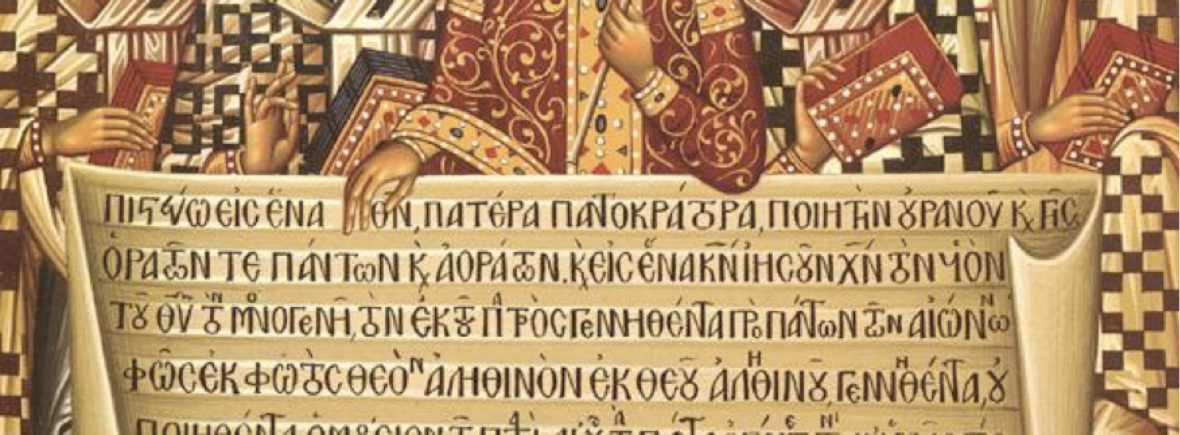
The Nicene Creed is a Christian statement of faith accepted by the Roman Catholic, Eastern Orthodox, Anglican, and most Protestant churches. It gets its name from the First Council of Nicaea (A.D. 325), where it was initially adopted, and from the First Council of Constantinople (A.D. 381), where a revised version was accepted. It is sometimes called the Niceno-Constantinopolitan Creed to distinguish it from the original 325 version.
The original creed adopted in 325 ended just after the words, “We believe in the Holy Spirit…” Content was added at the First Ecumenical Council of Constantinople in 381. The Third Ecumenical Council in Ephesus (431) reaffirmed the creed in this form and explicitly forbade making additional revisions to it. There have been other subsequent creeds formulated to guard against perceived heresy, but the Niceno-Constantinopolitan Creed, as revised in 381, was the last time both the Western (Catholic) and Eastern (Orthodox) churches were in united agreement on a creed. It should not be confused with the later Athanasian Creed.
The Creed is traditionally confessed each Lord’s Day when the Sacrament of the Altar is received. Also known as the Pisteuo (“I believe”), it contains the dogmatic truths of our Church that summarize everything the Scriptures teach for our salvation. We confess this creed because it confesses the truth given in the Holy Scriptures.
The Nicene Creed
I believe in one God, (Rom. 10:10; Deut. 6:4; Mark 12:29; James 2:19)
the Father Almighty, (Matt. 6:9; Ex. 6:3)
maker of heaven and earth (Gen. 1:1; John 1:1; Acts 14:15)
and of all things visible and invisible. (Col. 1:15–16; Heb. 11:1–3)
And in one Lord Jesus Christ, (Rom. 10:9; 1 Cor. 8:6; Rev. 17:14; Matt. 23:8–10)
the only-begotten Son of God, (John 3:16, 18; Matt. 16:16; Rom. 1:3; Ps. 89:27–28; John 1:18; 2 Pet. 1:17)
begotten of His Father before all worlds, (John 1:2, 14; Col. 1:15–17; 1 John 5:1)
God of God, Light of Light, (John 17:22; John 8:12; John 1:1, 9; 2 Cor. 4:6; 1 John 1:5–7)
very God of very God, (Col. 2:9; John 20:28; John 18:4–8)
begotten, not made, (John 1:2)
being of one substance with the Father, (John 10:30; 2 Cor. 4:3–5)
by whom all things were made; (Heb. 1:2–4; John 1:1–5; John 17:5)
who for us men and for our salvation (1 Tim. 2:4; Rom. 3:23; Eph. 1:3–4)
came down from heaven (John 6:41; Luke 15:20)
and was incarnate by the Holy Spirit of the virgin Mary (Luke 1:34–35; Matt. 1:20–23; 1 John 1:1–4)
and was made man; (John 1:14)
and was crucified also for us under Pontius Pilate. (Mark 15:25; John 19:16–18; 1 Cor. 1:22–24; 1 Cor. 2:2; Gal. 2:19–20; Gal. 6:14; Matt. 16:24; Luke 9:23; Luke 14:27; 1 Cor. 1:17)
He suffered and was buried. (John 19:1–3; Luke 23:53)
And the third day He rose again according to the Scriptures (1 Cor. 15:3–8; Luke 24:6; Phil. 2:5–11; Col. 2:17–20; Col. 2:9–15; Rom. 6:5–11)
and ascended into heaven (Acts 1:9; Luke 24:5–53)
and sits at the right hand of the Father. (Acts 7:55; Heb. 12:2)
And He will come again with glory (Matt. 16:27; Matt. 24:30–31; Matt. 26:64)
to judge both the living and the dead, (Acts 10:42; Matt. 3:12)
whose kingdom will have no end. (2 Pet. 1:11)
And I believe in the Holy Spirit, (John 14:16–17, 26; Gen. 1:2; Acts 2:38)
the Lord and giver of life, (Gen. 1:2; John 3:6; Gen. 2:7; Gen. 6:3)
who proceeds from the Father and the Son, (John 15:26; John 20:21–23)
who with the Father and the Son together is worshiped and glorified, (Matt. 3:16–17; Luke 2:14; 1 John 5:6)
who spoke by the prophets. (Ezek. 11:5; 2 Pet. 1:20–21; Eph. 1:22–23; Rom. 1:5; 1 Cor. 15:3)
And I believe in one holy Christian and apostolic Church, (1 Pet. 2:5, 9; Eph. 2:19–22; Rom. 11:16)
I acknowledge one Baptism for the remission of sins, (Matt. 28:19–20; Col. 1:13–14; Eph. 4:4–6; Acts 2:38)
and I look for the resurrection of the dead (1 Cor. 15:35–49; 1 Thess. 4:13–18; Phil. 3:20–21)
and the life✚ of the world to come. (Mark 10:29–30; Matt. 10:40–42; 1 John 1:24–25; John 17:1–3)
Amen. (Ps. 106:48)

Scripture references compiled from Theopedia and Wikipedia.