

4 October 2026 • Trinity 18 • Matthew 22:34–46
In the Holy Name of + Jesus. Amen.
There is a little monk in all of us. Luther said so. And of course he would know what it means to be a monk. He was one. And Jesus spends, in our Gospel text, this Tuesday of Holy Week, three days before His cross, taking that little monk apart.
The little monk is the voice inside you that says real service to God is somewhere else—not in the chores or the job or the everyday places where life unfolds: the kitchen table, the barn, the classroom, the hospital bed. The little monk says real service to God must be something special, something extra, something you’ll get to later—when the harvest is in, the kids are grown, you retire, and life slows down. Then you’ll finally do something good for God.
Now, of course, in Luther’s day the little monk wore a hood. He fasted on all the right days. He prayed at the right hours. Some of them even walked out into the wilderness, thinking that would make them holy, escaping from creaturely comforts. But in our day the little monk doesn’t wear a hood anymore. He wears work boots. He’s too busy. But he believes exactly what the old monks believed: that what God commanded is ordinary, and ordinary can’t count.
So we actually look down on the very works God has given us to do within our vocations. Changing a diaper doesn’t feel like worship. It doesn’t smell like worship. Running the combine past midnight doesn’t feel like worship either. Driving your mother to her appointment for the third time this month doesn’t feel like worship either. It just feels like getting through the week. And so we do it grudgingly, or halfway, or not at all, because we tell ourselves God wants us doing something else.
That’s one face of the little monk. But here is the other.
If what I do on Monday doesn’t count, then the people I meet on Monday don’t count either. The neighbor at my elbow becomes an interruption. My wife becomes a schedule. My children become a problem to be managed. The man I work beside becomes someone to beat. The customer becomes just another sale. And all week long we chase the thing that does seem to count, which is money, and we step over the neighbor to get it.
Jesus answers that little monk. “‘You shall love the Lord your God with all your heart, with all your soul, and with all your mind.’ This is the first and great commandment. And the second is like it: ‘You shall love your neighbor as yourself'” (Matt. 22:37–39).
Like it. The second is like the first. What you do to your neighbor, you do to God. Before this day is over, Jesus will say it outright: “Inasmuch as you did it to one of the least of these My brethren, you did it to Me” (Matt. 25:40). The sharp word at the supper table was said to God. The corner cut on your job was cut against God. The visit you didn’t make to the nursing home was a visit you refused Him. If we knew that, if we believed that, we would actually be terrified. The little monk has not been serving God somewhere else. He has been failing God right here, at the elbow, every day.
So let’s go back to the Gospel. We’re in the temple courts again on Tuesday. Jesus has already silenced the Sadducees. The Pharisees huddle, trying to come up with the next play, and they send in a lawyer. “Teacher, which is the great commandment in the law?” (Matt. 22:36).
The lawyer stands in the temple. Everything around him is special. Monk things. The gold, the altar, the priests at their holy work, the smoke of the sacrifices going up. It smells like church there. The lawyer expects a temple answer. The greatest thing, the greatest commandment, must be what happens here.
But Jesus gives him a kitchen answer. Love God. Love your neighbor. Not the priests’ work. Not the sacrifices—God-ordained, to be sure. But the ordinary things God commanded everyone to do: the farmer and the tailor, the maid and the magistrate, the child and the old man. There is no ladder here, no hierarchy. No higher class of Christian. No special work for special people. Just love, commanded of all of us, and in truth kept by none of us.
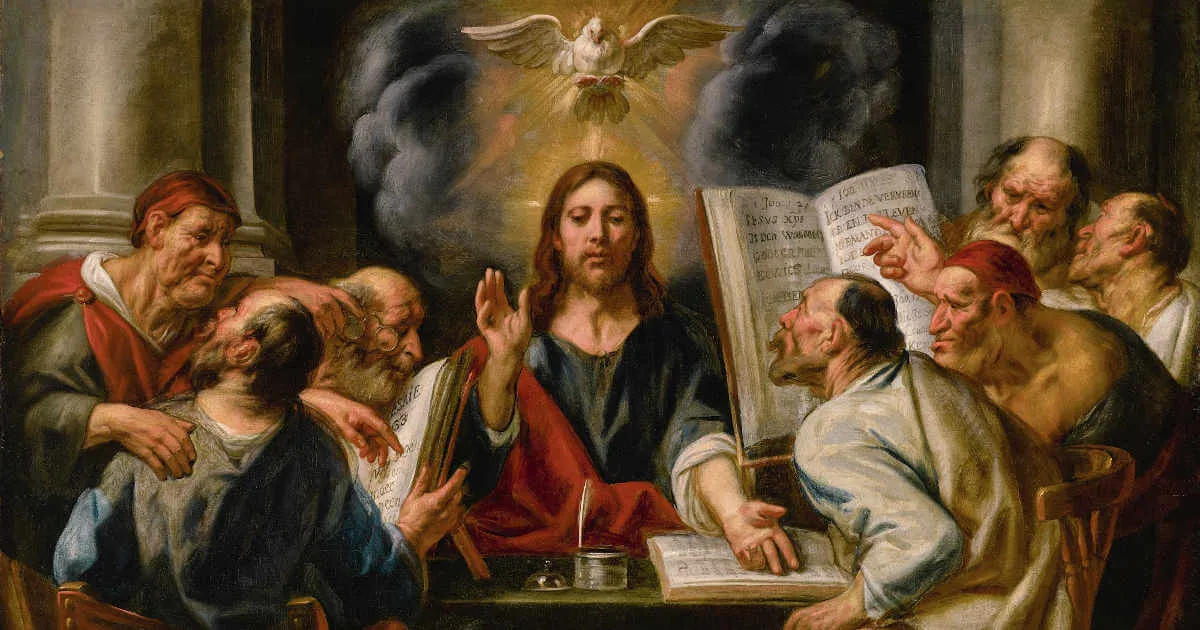
Then Jesus asks His own question, as He is wont to do. “What do you think about the Christ? Whose Son is He?” (Matt. 22:42). And there is a point to His question. They know the answer they were taught, and they answer rightly: the Son of David. So Jesus hands them David’s own song: “The LORD said to my Lord, ‘Sit at My right hand, till I make Your enemies Your footstool'” (Matt. 22:44). If David calls the Messiah Lord, how is He also David’s son? And of course “no one was able to answer Him a word” (Matt. 22:46).
They could not give the answer, the true answer. David’s Son is David’s Lord. The Man standing before them, with the road dust between His toes, is the God—the same God, the same Lord—who wrote the commandment. And look what that God did with His ordinary days. Look how He kept His own command.
For thirty years He did not live in the temple, serving before the altar there. He lived in His father’s carpenter shop. The people of His hometown knew Him by the trade: “Is this not the carpenter, the Son of Mary?” (Mark 6:3). He honored His mother. He worked for His neighbors. And every ordinary day of it He loved His Father with all His heart and His neighbor as Himself. He kept the first commandment and the second, in the shop and on the road and, at the end of the week, the week of our Gospel, on the cross.
And He kept it for you. That’s why He came. He came all the way down and did what the little monk never does. Everything you left undone at your elbow, He took care of. Every neighbor you stepped over, He stopped for. Every sin you committed against God by sinning against your neighbor, He carried to His cross on Friday and paid for there. And now David’s Lord sits at His Father’s right hand. The monk tries to climb up to God, but the Lord sits. The work is finished.
Later that same day, Jesus looks out over Jerusalem and says, “How often I wanted to gather your children together, as a hen gathers her chicks under her wings” (Matt. 23:37). And that is what He does for you. He spreads His wings over you. He covers your shame with His righteousness. And while you stay under His wings, the sin still in you is not counted against you.
That’s what changes on Monday—tomorrow. God does not count the wrongs you have done your neighbor against you. He has forgiven them. But the good you do for your neighbor, He counts as done to Him. Under Christ’s wings, the ordinary work, the ordinary vocations, are indeed holy work—not because you did it well, or perfectly, or even completely, but because you are His. That is why Luther could say that a maid who has faith in Christ, dusting around the house, pleases God more than even St. Anthony, the most famous hermit of the old church, who prayed day and night in the wilderness. Not because dusting the house is better than praying, of course, but because the maid is covered by Christ. And so her dusting is done to God.
Which means that the diaper does count. The combine at midnight counts. The drive to your mother’s appointment counts. The lesson plan for school counts. You don’t climb to God through them. He came down to you, in the kitchen and in the field. Luther said that in this way every house becomes a true church. Your house is a church. Your barn, where two or three are gathered, is a church. Your hospital room is a church. Because Christ is there, covering you.
This morning we prayed, “Without You we are not able to please You.” That’s the truth about the little monk. Without Christ, not one of his special works pleases God. But with Christ, even the dusting does.
A hen does not only cover her chicks. She feeds them too. And so your Lord does both. He covered you at the font, when He put His name on you and His righteousness over you. And now He feeds you at His altar. Ordinary bread and ordinary wine, the work of human hands like yours. And in, with, and under the bread and wine, His own body and blood, given and shed for you, for the forgiveness of all your sins.
So come with the dirt still under your fingernails. Come with the argument from breakfast still weighing on your conscience. Come with the thought of the neighbors you failed. Kneel here and be covered. Open your mouth and be fed.
And then go home. Your home is your church now too. Your work is His, because you are His.
In the Name of + Jesus. Amen.
Rev. Christopher R. Gillespie
St. John Ev. Lutheran Church & School — Sherman Center
Random Lake, Wisconsin