
18 October 2026 • Feast of St. Luke • Luke 10:1–7
“But whatever house you enter, first say, ‘Peace to this house.’ And if a son of peace is there, your peace will rest on it; if not, it will return to you” (Luke 10:5–6).
In the name of the Father and of the Son and of the Holy Spirit.
“Peace to this house.” That is the first thing the Lord tells the seventy to say. Not “let me tell you about my church.” Before they tell anyone anything, before they even sit down, before they eat, before they do anything, they speak the Lord’s peace over the door.
Now, we usually hear this text for St. Luke’s Day as a text about evangelism, about going. Jesus appoints seventy others, sends them out two by two, tells them the harvest is great and the laborers few. So we rightly hear it as a mission text. Everyone is sent. So get out there. Get going. We often hear it too, though, in regard to the pastoral ministry: what we look for in the man who comes to the door with the Word.
Both are in it, to be sure. But listen to where our Lord’s words end for us today. They end in a house. “But whatever house you enter, first say, ‘Peace to this house.’ And if a son of peace is there, your peace will rest on it; if not, it will return to you. And remain in the same house, eating and drinking such things as they give” (Luke 10:5–7). The road is short. The Lord means to arrive at a house.
Peace to this house.
“The Lord appointed seventy others also, and sent them two by two before His face into every city and place where He Himself was about to go” (Luke 10:1). Before His face. They are the forerunners. The seventy walk ahead of Jesus the way a voice carries ahead of the man coming down the lane. Where they go, He is about to come. So when one of them stands at your door and says “Peace,” it’s not his peace that he’s giving. The man standing there has no peace to give of his own. He doesn’t have anything, actually. As Jesus said, he carries no money bag, no knapsack, no sandals. He just comes with empty hands. And even what he has in his mouth for you, it belongs to the Lord, who is right behind him, on His way.
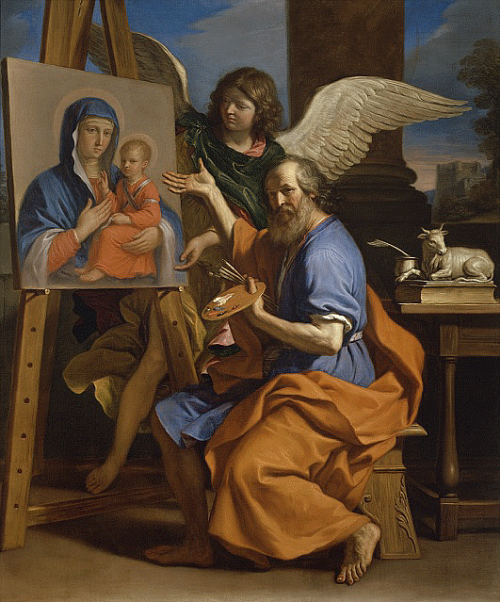
Of course, we read this Gospel today on St. Luke’s Day. And you say, well, why? Some writers guessed that Luke was one of the seventy. Of course, there’s no explicit evidence to say so. But Luke tells us himself that he got his Gospel from those “who from the beginning were eyewitnesses and ministers of the word” (Luke 1:2). In other words, Luke wasn’t the man at the door. Luke was the one in the house who heard the word “Peace to this house” from eyewitnesses. And it is remarkable: Luke, a Gentile and a physician. Someone brought him the Word, and the peace rested on him there. And then Luke did what a house does when the peace stays. He kept it. He wrote it down in order, “that you may know the certainty of those things in which you were instructed” (Luke 1:4).
Actually, if you stop to think about Luke’s Gospel a bit, you’ll find there are a lot of houses in it. Later in this same chapter, “a certain woman named Martha welcomed Him into her house” (Luke 10:38). In Jericho, Jesus looks up into a tree at a crooked tax collector and says, “Zacchaeus, make haste and come down, for today I must stay at your house” (Luke 19:5). And when the grumbling starts, He answers it: “Today salvation has come to this house” (Luke 19:9). Zacchaeus’ house. In other words, peace to this house. Salvation to this house. The same gift, carried to the same kind of door.
But the Lord also told us that something else might happen at the door. “If a son of peace is there, your peace will rest on it; if not, it will return to you.”
The peace can go back.
And the Lord means that. A house can hear peace spoken and then turn it away. Send it back. Most houses won’t slam the door in your face. They’ll smile and nod, but they’ll never let it in. So too, you can hear “The peace of the Lord be with you always” every Sunday of your life and answer “Amen.” And then walk out to the car and leave it here, not take it with you. The word came near. And it went back to the One who sent it, because no one in the house wanted it. They wanted to be left alone. Say it another way: they wanted to run their own house.
Of course, there is another way you can send back the word of peace. Some of you might hear “if a son of peace is there” and think, well, that’s not me. A son of peace must be someone who’s calmer than I am. Someone whose life is in order. Someone who doesn’t fight with his brother over the farm, who isn’t behind on the bills, who doesn’t lie awake at three in the morning. You hear the condition, the need for peace, and you count yourself out. It sounds humble, but it’s sending back the Lord’s peace all the same.
So who is a son of peace? When the Bible calls someone a “son of” something, it means that he belongs to it. A son of peace is one to whom peace belongs. Not because he earned it, but because he’s the one it was sent to. And here, of course, today, it is sent to you.
Remember how the seventy came. No bag, no money, no extra shoes. And the Lord did that on purpose. He wanted nothing at the door but His word. The peace does not wait for you to sweep the house. It doesn’t check whether the bills are paid. The servant speaks it first. “First say, ‘Peace to this house.’” Before you’ve cleaned up. Before you’ve straightened out your life. Before you’ve even repented. Before you’ve proved a thing.
Of course, He can speak it first. Jesus can, because of where He is going. Just before our reading today, St. Luke tells us, Jesus “steadfastly set His face to go to Jerusalem” (Luke 9:51). That’s the big turning point in the Gospel. The seventy go before His face, and His face, we just heard, is set toward the cross. So when He says, “Behold, I send you out as lambs among wolves” (Luke 10:3), well, He, of course, is the Lamb, and the wolves do take Him. They nailed Him up outside the city. And there He made peace for this house “through the blood of His cross” (Colossians 1:20). Everything that you think cannot have that peace supplied, well, the cross proves it can. The fight over the farm, the lies, the grudge, the worries that keep you up: He carried every one of them there. And on Easter evening, He stood among His terrified disciples, and the first thing He said to them was, “Peace to you” (Luke 24:36). Peace to this house.
So the peace doesn’t just stay out on the road. It “remains in the same house,” Jesus says. The peace stays. The peace of Christ is sticky. It rests on the house. It sits down at the table. Then the Lord turns the whole thing around. In the Gospel, the house feeds the messenger, “eating and drinking such things as they give, for the laborer is worthy of his wages” (Luke 10:7). Obviously, you know, that’s used in the Small Catechism, the Table of Duties. The congregation feeds the ones who bring them the Word, and it should.
But this morning it goes the other way. The Lord has come into this house, and He is the host. He does not eat what you set before Him. He sets Himself before you. His body, given for you. His blood, shed for you. And just before you come to His table, His servant will turn to you and say the very thing the seventy were sent to say: “The peace of the Lord be with you always.”
Now maybe you just hear that each week as kind of a nice greeting. That’s if you’re not listening. It is the Lord’s peace. Spoken first, spoken to you, coming before you’ve done a thing. That word is proclaimed to you whether you think you’re worthy. It makes you a son of peace by coming to you. It rests on you. It prepares you then to receive Christ’s body and blood. And it’s sticky, as I said. You get to take it with you. Take it home to your table, to your kitchen, to your barn, to your bed.
Peace to this house. Peace to you.
In the holy Name + of Jesus. AMEN.
Rev. Christopher R. Gillespie
St. John Ev. Lutheran Church & School — Sherman Center
Random Lake, Wisconsin