

19 August 2026 • Friday of Trinity 11 (observed) • 1 Corinthians 9:19–22; Luke 17:20–37
This is the Word of the Lord that came to me, so that you may believe that Jesus is the Christ, the Son of God, and that by believing, you may have life in His + Name. AMEN.
The Pharisees ask Jesus “when the kingdom of God would come” (Luke 17:20). Not whether. When. They want the date. Maybe you’ve asked it too. We’ve looked at our country, and maybe you’ve looked at your own family, or at the size of this congregation, and wondered how long, O Lord — when is God going to do something about it.
Jesus won’t give a date. He takes the question apart. “The kingdom of God does not come with observation” (Luke 17:20). That is to say: no signs to check off. No headline to tell you it has started. You will not be able to point at it. As far as you’ll be concerned, everything is normal. Then He names the two places we do look, and He rules out both.
The first is out there. “Nor will they say, ‘See here!’ or ‘See there!’” (Luke 17:21). Some other congregation, some other movement, some other year. This is the oldest religion there is, and it requires no faith at all — only that you keep looking, lusting, coveting. So we watch. We tell ourselves that if only the right man got in, or the right law passed, or the school filled up again, God would finally be visibly at work in our country, in our community, here in Sherman Center. Care about those things, of course. It isn’t wrong to. But every one of them can go exactly the way you want, and God will be no nearer to you than He is here for you tonight.
Second, we also look inside. And here Jesus says the sentence that has been twisted for two thousand years since He first spoke it: “For indeed, the kingdom of God is within you” (Luke 17:21). The verse everybody loves. Look inward, search your heart, find the spark to get the fire going. It’s even on coffee mugs. But that is not what the word means here. It is better rendered in the midst of you — you plural, among you all. In your presence. In the disciples’ presence. In the Pharisees’ presence. Jesus is not telling these Pharisees — the Pharisees! — that the kingdom of God is glowing quietly in their chests. He is telling them it is standing right in front of their faces, and they cannot see Him.
Of course, we don’t want to let ourselves off here either. You’re in church on a Wednesday night in August; nobody made you come. So the crude version isn’t yours. The churchgoing version might be. It’s when you measure what happened here tonight by what you felt. Did the hymn move me? Did the sermon reach me? And if the answer is no — if you were tired, or your mind was wandering to work, and the truck, and whether the child is going to be all right — you go home thinking not much happened tonight.
That is the same error as the Pharisees who look within. The kingdom of God within you: your own heart made the place where you check whether God showed up. The old word for this is enthusiasm. It doesn’t mean you’re really excited. It means God-within-ism. And your heart is the worst instrument you own. Scripture teaches us that our heart is a liar on our good days and a prosecutor, an accuser, on our bad ones, and it can tell you nothing whatsoever about whether God is truly present in the midst of you.
So He’s not out there, and He’s not in your chest. Then where?
Here is the sentence in the middle of the Gospel that you might have missed. “But first He must suffer many things and be rejected by this generation” (Luke 17:25).
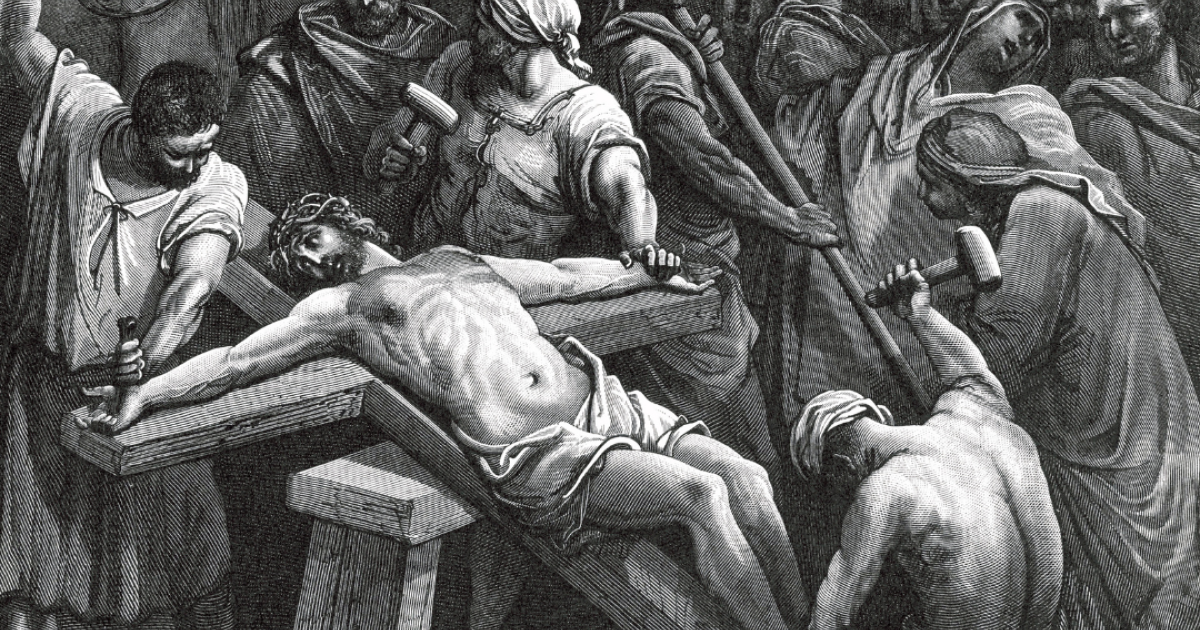
First. Before the lightning. That is why you cannot see this kingdom by looking. At this hour it is located in a Man who will be arrested and flogged, tried, of course, and then hung up outside the city where His own people can watch Him die. And Jesus says: that’s the kingdom of God. It doesn’t look like a kingdom. It looks like a failure. It was made to look like a failure. And a kingdom that comes that way will never once turn up where you were looking for it.
Then He says the thing that ought to frighten you most.
“As it was in the days of Noah… they ate, they drank, they married wives, they were given in marriage” (Luke 17:26–27). “Likewise as it was also in the days of Lot: They ate, they drank, they bought, they sold, they planted, they built” (Luke 17:28).
You hear the list? Where is the sin in any of it? Eating. Drinking. Marrying and giving in marriage. Working, buying, selling. Planting. Building. Those are all good things. Not one thing there that God hasn’t commanded or blessed. That’s a barn going up and a crop in the ground. And then the flood came, and the fire fell, and it destroyed them all.
He’s telling you what it actually looks like to be lost: it looks like an ordinary Wednesday night. Nobody in Noah’s day thought himself wicked. They thought themselves busy. The judgment fell on people doing nothing wrong in particular, who weren’t watching the one man building a boat.
So also Jesus says, “Remember Lot’s wife” (Luke 17:32). She was out. Rescued, on the road, the fire already behind her — and she turned her head. She isn’t the pagan in Sodom. She’s the one already saved who looked back. Jesus doesn’t tell you to remember Sodom. He tells you to remember her.
“Whoever seeks to save his life will lose it, and whoever loses his life will preserve it” (Luke 17:33).
Now hear the Epistle, because there we hear Paul reflecting on all of it. “Though I am free from all men, I have made myself a servant to all” (1 Cor. 9:19). Paul is free. He’s living in the resurrection. Nobody owns him. And he spends that freedom — not by being busy, but by handing it all away: “to the Jews I became as a Jew… to the weak I became as weak” (1 Cor. 9:20, 22). He is the sort of man who disappears into every room he preaches in. You couldn’t pick him out of a crowd. That isn’t a technique for church growth. It is Paul living out Jesus’ own word — whoever seeks to save his life will lose it, and whoever loses his life will preserve it. There is Paul, giving his life away for others, and thereby preserving it.
Where did he ever get that idea? He learned it from Someone. Christ was free from all men — free as only God is free — and made Himself a servant to all. He became as one under the Law, to redeem those under the Law. He became weak. He was made sin for us. He was made a curse for us. He lost His life, and by it preserved yours.
And look again at who rejected Him. “Rejected by this generation” (Luke 17:25) — not by strangers, but by His own, by the religious, by the Pharisees, by people who had waited their whole lives for the kingdom and did not know it when it stood right in front of them. Rejected, maybe, by us. He was rejected by this generation so that this generation would not be rejected. That is why the Day, when it comes, is not a threat to you. The judgment you are waiting for — the one you may even fear, the one Jesus has caused you to wonder about, maybe I am like Lot’s wife, maybe I am like those in the days of Noah — that judgment already fell. It fell on Him, outside the city, in the dark.
That is the kingdom you couldn’t find by looking for it. It never came with observation, Jesus said so, because it came in a Man too ordinary to notice and too disgraced to follow. So the disciples finally stop asking when. “And they answered and said to Him, ‘Where, Lord?’” (Luke 17:37). Where. The right question. Not when will God act — where is He for me?
And Jesus answers: “Wherever the body is, there the eagles will be gathered together” (Luke 17:37).
One way to hear that is grim — vultures over a corpse. But in researching this text, which I never had occasion to preach before, I found Saint Ambrose — Saint Augustine’s father in the faith — who heard it and said: look at the eagles gathered around the body, the women and the apostles at the tomb of the Lord. Then he puts you in the picture: the body is that of which it was said, My flesh is meat indeed — and around that body, you are the eagles that gather.
Where, Lord? Wherever the Body is! You aren’t asked to find the kingdom of God. You’re already told where the Body is. Not out there where you’ve been watching and waiting for signs and seasons. Not in your chest, where you’ve been feeling around, wondering, do I feel moved tonight? Here. On this altar. In a piece of bread you couldn’t tell from any other — as unremarkable as an ark standing in a field, just another man building a boat.
You came in tonight maybe not feeling much. That doesn’t matter, and it never did. The Body is here whether your heart reports it or not. The kingdom of God does not come with observation — it isn’t about the scale of the thing, or the number of people present — and it does not come with sensation either. It comes where Christ says it comes, where He puts Himself and is for you. Received by faith.
And one day the waiting ends, and it will not be hidden from us. “For as the lightning that flashes out of one part under heaven shines to the other part under heaven, so also the Son of Man will be in His day” (Luke 17:24). You won’t need a preacher to point out that it is the Day of the Lord. Lightning, thunder, signs in the moon and the stars. And you won’t have to ask where He is, because you will see Him. And the eagles will gather — you among them — because He has been gathering you to His Body all along.
Thanks be to Jesus, in His holy Name. AMEN.
Rev. Christopher R. Gillespie
St. John Ev. Lutheran Church & School — Sherman Center
Random Lake, Wisconsin