
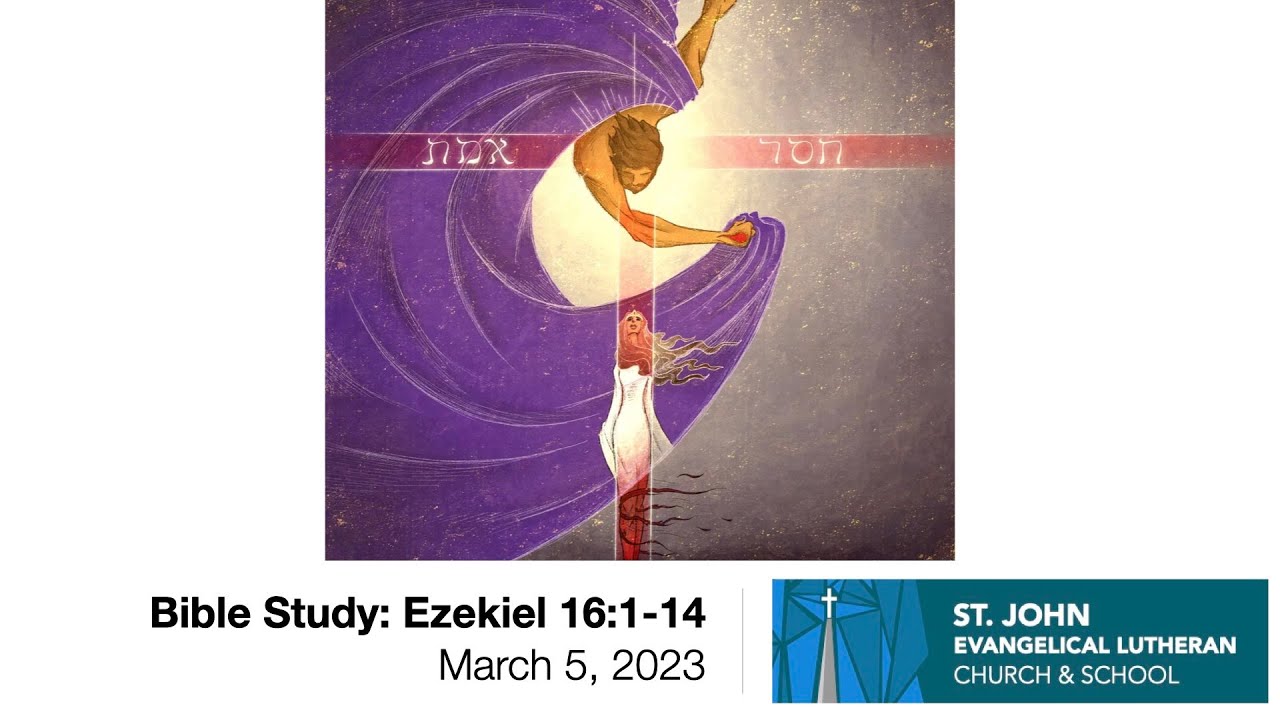
Ezekiel – 16:1-14
God’s Love for Jerusalem and Jerusalem’s Harlotry – Chapters 16 & 23 provide bookends for the intervening chapters in an ABABAB pattern. Chapter 16 is longer than half of the minor prophets. There are over a dozen unique words (hapax legomena) and other obscure words. A family theme runs through the chapter with the leading motif of marriage, with depravity marked by derivatives of the root “to be a whore, prostitute” over twenty times. Not surprisingly, Ezekiel, trained as a priest, is shockingly explicit and thus often translated euphemistically, but with a frankness like Leviticus. it is meant to o end to the point of shame. Remember the covenant and the curse for breaking it of Leviticus 26. First, Yahweh’s righteous jealousy brings just retribution for unfaithfulness, with adultery a capital crime for both sexes (Lev 20:10). Second, the ultimate purpose is to evoke repentance, restore the original relationship, and even establish something more—the new covenant with Christ, “where sin abounded, grace did much more abound” (Rom 5:20). It is the longest single oracle in the OT, a powerful expression of God’s wrath and His love—Law and Gospel. The major point of comparison is Israel’s gross unfaithfulness in contrast to God’s gracious love. Rather than an allegory, it is more of a parable. The OT suggests that Yahweh wedded Israel as His wife through His exodus redemption of her (Ex 34:15-16; Lev 17:7; 20:5; Deut 32:15-18). Song of Songs, Psalm 45, Isaiah 61:10, 62:1-5, Hosea 1-3, and Jer 2-3 all embody the theme. The NT uses the theme for Christ and the Church (Eph 5:21-33), the wedding parables (Mt 22:1-14; 25:1-3), Rev 21:9, and sayings such as Lk 5:34-35 and Jn 3:29-30. Idolatry is often depicted as spiritual adultery, e.g., Rom 1:18-32; 1 Cor 6:12-20; Gal 5:16-26. Jerusalem’s Infancy, Rescue, Puberty, Marriage, and Adornment by Grace (16:1-14) Jerusalem’s original call is by grace, shown by the covenant history. Yahweh (Jesus!) is concerned about her spiritual descent, not blood (See John 8:31-59). Many had engaged in mixed marriages with Canaanites, Amorites, and Hittites. Moses married a Cushite (Num 12:1), and by grace, various foreigners had been incorporated into Israel (e.g., Rahab, Gibeonites, Ruth). The issue is Israel adopting many of their pagan neighbors’ religious beliefs and practices. Israel failed to exterminate the Canaanite idolaters with their idolatry (Josh 13:1-7; Judges 1–3). Jerusalem had paganism in its blood. Regarding…