
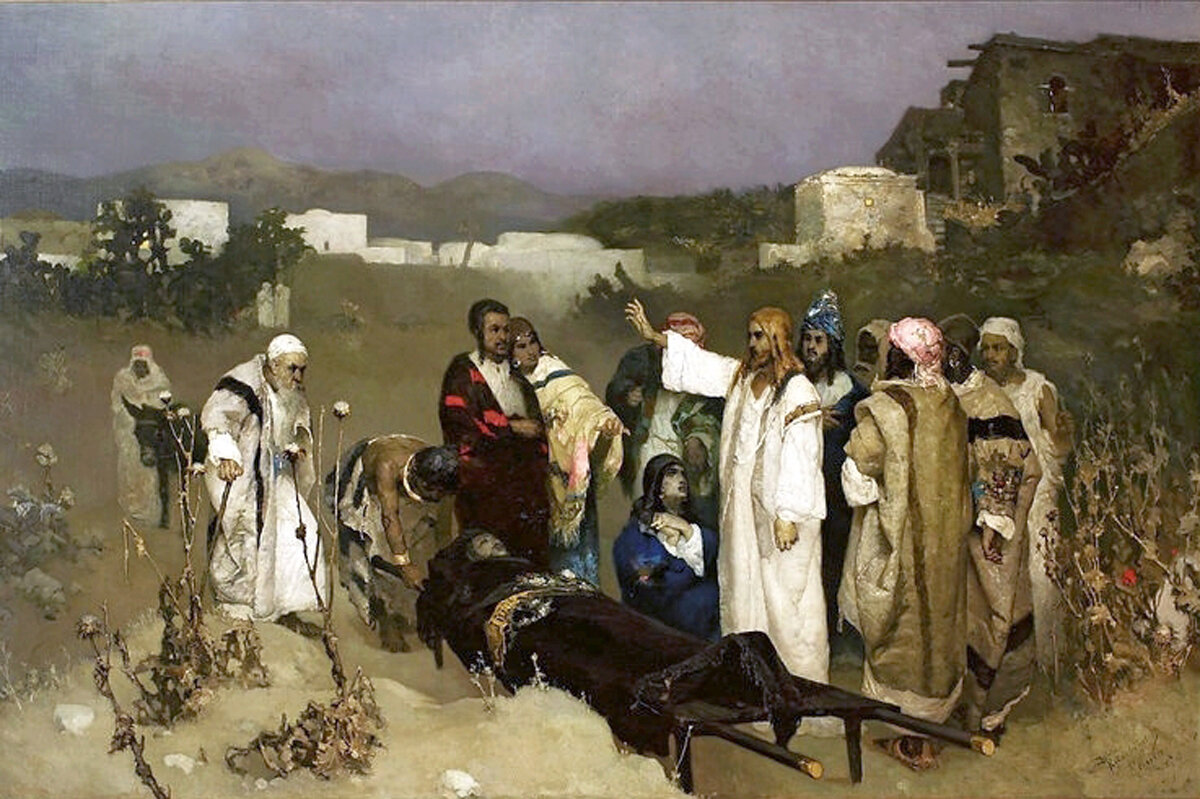

20 September 2026 • Trinity 16 • Luke 7:11–16
“When the Lord saw her, He had compassion on her and said to her, ‘Do not weep'” (Luke 7:13).
In the Name of the Father and of the Son and of the Holy Spirit. Amen.
What would you say to a woman walking behind her only son’s open casket? Now, you know this walk. The line of cars along the highway with the headlights on at noon, everyone coming the other way pulling onto the gravel to let it pass. Nobody cuts in front of a funeral procession. It has the right of way over everything alive.
And this procession, the one we heard today, had a right to it too. Her husband was already in the ground. This was her second time out of that gate. The boy was the last one bound by blood and by law to care for her, to feed her. St. Luke says “her only son,” and then, “and she was a widow.” When the boy went into the ground, the last of her bread went with him.
“And a large crowd from the city was with her” (Luke 7:12). So what did they say to her? What does anyone say? You’ve had your turn at the door of the receiving line. He’s in a better place. Time heals. Let me know if you need anything. Now, every one of those is a kindness of a sort, but in the end, not one of them is worth a thing. We say these kinds of words because we have nothing to say. So they walked with her. They wept with her. That was all the crowd could do. It can walk.
And then there is the oldest thing to say, which you don’t say at the door. The widow says it to herself at three in the morning, and nobody interrupts her. What did I do? The other widow, the one from last Sunday whose flour never ran out — and we heard her again today — said it straight to the prophet’s face when her boy stopped breathing: “Have you come to me to bring my sin to remembrance, and to kill my son?” (1 Kings 17:18).
So every grave does that arithmetic. Someone is dead, therefore someone is guilty, and I know who. Maybe it was my fault. That is the Law, and the Law is always right about the guilt and always wrong about what comes next. The pallbearers are the preachers of the Law. They carry you out, and they never once set the casket down until it goes in the ground. That is their whole job. That is what the Law does.
But today a stranger comes from the other way, and He interrupts. Nobody in Nain had sent for Him. Read it again: she did not pray for Him. The boy certainly did not. There’s no faith in this story anywhere. Here you have an example, not of faith, but of the pure grace of God and the lovingkindness of God. Which means the whole thing runs the wrong way for us. What we want is the faith first and the miracle after, as if it were the reward. But she did not ask. She had already resigned herself to the fact that he was dead forever. But when Jesus came to the gate on that day, at the hour the casket came out of it, He looked at her, and St. Luke uses the word for what happens in your stomach when you see a thing like that, and He said the one thing you are not allowed to say at a funeral.
“Do not weep” (Luke 7:13). Stop crying. To a mother. At the gate, with the boy in the casket in front of her.
So who says that? Maybe try to do that at the next funeral visitation you go to. Tell the widow in the front row to stop crying. You probably won’t get to your second sentence. Two men in dark suits will come and take you out by the elbows for being so disruptive. Who but a madman would tell a mother not to weep at the funeral of her son? A madman. Or God.
So He has given her a command with nothing under it yet. Her son is still dead when He says the words. The boy is still cold and gray. She has not one reason on earth to obey Him, and He has just handed her one more thing that she will fail at. That is how we hear it, because we are Law all the way down. Someone gives us a word, and we go looking for the grounds to dismiss it. Sit the boy up, then tell me to stop crying, and then maybe I’ll consider it. We want the deed first and the word after. But that is exactly backward, and it is the only way a sinner can think.
But Christ doesn’t think that way. He speaks first, and then the thing He spoke is so. “Young man, I say to you, arise” (Luke 7:14) came before the young man had done any arising. And “Do not weep” came before there was one dry reason in Nain to stop. The word had the deed inside it. She just couldn’t see it yet.
In her case, two seconds. He said stop. He touched the bier; the bearers froze. He spoke to the dead, and the dead sat up talking. She held that word with the boy still dead for about as long as it took Him to say it.
Now, you and I have to wait longer. That is the only difference between you and her. Four weeks ago we carried Dan out of this church. I dared to stand up here and say words over him. Not “he’s in a better place” — although that is true. I said a command with nothing under it: he will rise. This body is going into the ground and coming out. And Dan didn’t sit up. Not yet. We got the word, and the luncheon, and we have been holding “Do not weep” ever since with nothing in our hand but His word of promise.
And so there is this gap, this interval. And that is where the church lives. Between the command, “Do not weep,” and the promise, “arise,” with the bier still up on the shoulders or six feet under. You know this gap.
After the surgery, the pain is still there. The root of the sickness is out, the thing that was killing you excised and gone, and it hurts like it did yesterday. The surgeon says, “Don’t cry.” Not because you don’t hurt. Because the cause is gone, and the pain you have left is the pain of a body that is going to live. That is what it is like to hear “Do not weep” from Jesus.
The root of death was Christ’s problem, and He dealt with it. He finished it on a Friday, outside a different city gate, with a different mother watching her only Son carried out. Nobody stopped that procession. He let it go all the way to the tomb, and on the third day He was the One who sat up alive, the only Son of His Father. He is the only one at the gate who can say it. He has been through the grave from the inside, and He has the right of way now.
“Then He came and touched the open coffin, and those who carried him stood still” (Luke 7:14). The Law and its preachers have to stop the moment His hand is on the bier. But notice: He doesn’t pray. This is different from what we heard in the Old Testament, from Elijah over the other widow’s boy, who stretched himself out on the body three times and begged, “O Lord my God, I pray, let this child’s soul come back to him” (1 Kings 17:21) — let his nephesh come back into him. Elijah, a great prophet, and he had to ask. The crowd at Nain said the same of Jesus: “A great prophet has risen up among us” (Luke 7:16), probably thinking of Elijah and Elisha, who raised the dead. And they are half right. A prophet has to ask. This One says “I say to you” (Luke 7:14). Not a prayer sent up. The word of God sent down.
“And He presented him to his mother” (Luke 7:15). He gave him back. To his mother. To supper. Paul says God is “able to do exceedingly abundantly above all that we ask or think” (Ephesians 3:20). She didn’t even ask. She asked for nothing, and she got her son back. Now, for you.
You are the ones still walking behind the casket. And the word has already been spoken over you with nothing under it that you can see. At that font someone said, “I baptize you,” and you were joined to the death of a Man and to His rising. He promised it in the water. And yet you haven’t seen the rising yet. At this rail you will be told, “Take, eat; this is My body,” and you will taste bread — and receive the bread of heaven. Every word of it is “Do not weep,” spoken with the boy still dead.
But every word of it will come true the way it did at Nain. That is why this is recorded for our hearing, so that we believe. Because the One who said it is always the One who does it, and He doesn’t say what He can’t do. For us, compared to the widow, the interval seems long. Maybe your whole life, from the font to the resurrection. But it is not one second longer than He decided.
So hear it now, from a Man you did not send for, who came to this gate this morning and looked at you and had compassion on you. Do not weep. Your sins are forgiven you. Your dead are His. And on the Last Day He will stand at the graves and say a name, and it will be yours, and mine, and Dan’s, and He will say to all of us: “I say to you, arise.” And you will sit up and begin to speak. And He will bring you home.
In the holy Name of + Jesus. Amen.
Rev. Christopher R. Gillespie
St. John Ev. Lutheran Church & School — Sherman Center
Random Lake, Wisconsin