

11 October 2026 • Trinity 19 • Matthew 9:1–8
When Jesus saw their faith, He said to the paralytic, “Son, be of good cheer; your sins are forgiven you” (Mt 9:2).
In the Holy Name + of Jesus. AMEN.
“Son, be of good cheer; your sins are forgiven you” (Matt. 9:2). That one sentence carries all of the Gospel. Jesus says it to a man lying on a bed in Capernaum. The scribes hearing it chew on those words in silence. Jesus asks about it out loud. And by the end of the reading, the crowd is praising God for putting it into men’s mouths. Follow that one sentence this morning, and eventually it will bring you here, to the sanctuary, and it has your name on it.
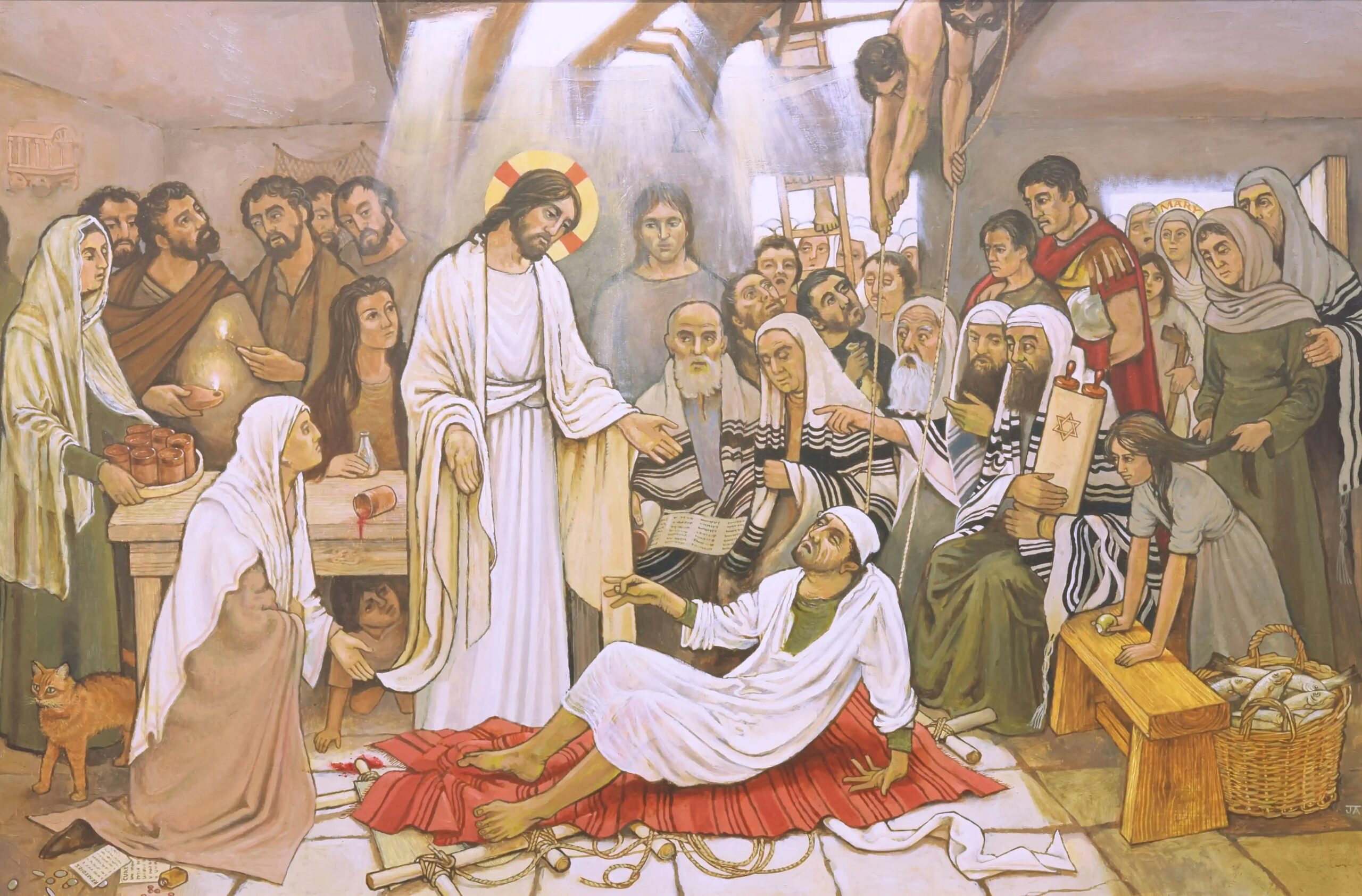
Let’s start where Matthew starts. Men carry a paralytic and set him down in front of Jesus. Anybody could see what was wrong with him. He couldn’t walk. And because he couldn’t walk, he couldn’t work. He couldn’t get himself anywhere, not even to Jesus. So they came to Jesus for the poor man’s legs.
But then Jesus looks at him and says nothing about his legs. “Son, be of good cheer; your sins are forgiven you” (Matt. 9:2). He didn’t say, “God forgives sinners.” He didn’t say, “There is mercy for everyone who repents.” Both are true statements, of course. And both would have been easier on the man, because a general truth lets you just stay in the crowd. But Jesus says to him, “your.”
Dr. Luther points out that “your sins” says two things at once. First, it says you are the sinner. But it also says that the forgiveness is for you. That same word does both. Before Jesus forgives the sins, He calls them yours.
Of course, that’s the Law in our text today, isn’t it? And it cuts right to the heart. We don’t mind talking about sin in general, as some kind of common malaise. We confess something like that every Sunday: we are by nature sinful and unclean. Dogmatically, we call that original sin. We. Plural. All of us together. But maybe nobody in particular. It’s easy to be a sinner in a crowd. Everyone in this sanctuary will admit to being a sinner. Fewer will admit to the sin. The one you’ve never said out loud. The one that wakes you up at two or three in the morning. The thing you said that you can’t take back.
Now, maybe some of you are already thinking of someone else who has sinned against you. That’s the scribes’ way of doing things. They sat in that house and found the sin in the room, but it was never their own. Jesus knew what they were thinking. “Why do you think evil in your hearts?” (Matt. 9:4). They said nothing out loud, but He heard all of it. And He hears yours too. The Law is not for the person three pews up, or a pew over. It is your sin, He says.
But others of you might hear “Your sins are forgiven,” and something in you says, “Well, but not mine.” Or, “Not that one.” You believe that God forgives. I think most people do. You believe that He forgives the world (John 3). You’re just not sure if you’re included in that broad statement.
Dr. C.F.W. Walther, the founder of the Missouri Synod, its first president, first seminary president, and pastor of seven churches. Okay, you don’t need to know more. He did have a story that he told about this in his treatment of today’s Gospel. I like his story. A city rose up against its king and lost. Every rebel was condemned to death. Then the king published a pardon for all of them. Most of the rebels read that public proclamation, and they went home satisfied. But the ringleaders had blood on their hands. They heard that same pardon, and they wondered, “Well, perhaps he didn’t mean us,” because of our guilt. What would settle it? What would finally appease their conscience, so that they believed that pardon was for them? A pardon with their own names written on it.
And that’s what Jesus gives to the paralytic. Not some general, abstract word of forgiveness that’s for all people, but a pardon with his name on it. Son. Your sins. Forgiven.
And of course, that’s what the scribes heard, and that’s why they said, “This Man blasphemes!” (Matt. 9:3). Now, they’re half right. Only God can forgive sins. The scribes knew their Bibles. The mistake wasn’t that rule. The mistake was the Man. The God who alone forgives sins was sitting in front of them in the flesh, and now they call Him, God, a blasphemer. You get the irony.
And they also wanted to keep forgiveness where they thought it belonged: in heaven, with God. Far away, general, safe. Not spoken in that house, in that town of Capernaum, to that man everyone knew. Not handed out by a Man you could reach out and touch.
So Jesus answers them. “Which is easier, to say, ‘Your sins are forgiven you,’ or to say, ‘Arise and walk’?” (Matt. 9:5). Which is easier to say? Both are just words. Anyone could say either one. I dare you to say it to someone who’s paralyzed: “Arise and walk.” Because only one of them you can actually check on, right? So He says the one you can check. “Arise, take up your bed, and go to your house” (Matt. 9:6). And the man gets up. His legs prove Jesus’ authority, or power. Our translation can’t decide. I said it both ways. They prove Jesus’ words. If He can say, “Arise and walk,” then He can say, “Your sins are forgiven you.” God in human flesh, the Creator of heaven and earth, speaking.
And thus He tells them why: “That you may know that the Son of Man has authority on earth to forgive sins” (Matt. 9:6). On earth. Not up there, or someday in the future, or somewhere else, or for somebody else. Here. In this crowded house, a few feet from the man on the mat. Dr. Luther says that Jesus says “on earth” so that we would stop gazing up into heaven to find out whether we are forgiven. You don’t climb up to it. It comes down to you.
And where did Jesus get the right to say it, anyway? Well, it cost Him His blood. “Without shedding of blood there is no remission of sins” (Heb. 9:22). The Man who said “Your sins are forgiven you” in Capernaum went on to Jerusalem, and there He bore that man’s sins, your sins, my sins, in His body, to the tree (1 Pet. 2:24). Calvary is where forgiveness was won for you, for me.
That’s why Matthew gives that startling last line. “Now when the multitudes saw it, they marveled and glorified God, who had given such authority to men” (Matt. 9:8). To men. It’s curious, isn’t it? Because we were just talking about Jesus’ authority, the Man. And now it’s men, plural. The crowd said more than they probably knew. They’re anticipating what will come, what Jesus would do for you and for me after Easter. He breathed on His disciples and said, “If you forgive the sins of any, they are forgiven them” (John 20:23). “Whatever you loose on earth will be loosed in heaven” (Matt. 18:18). On earth. There it is again. The authority that Jesus has, He gave to His Church.
And so you get to hear it here on earth, every Sunday, in the stead and by the command of your Lord Jesus: I say to you, “I forgive you all your sins.” Of course, not because your pastor is holier than you. I stand under the same word. I need it said to me as much as you need it said to you. The forgiveness is His, and He put it on earth, in a man’s mouth, so that you could hear it with your ears. Not generally, not just reading it, but put into you, declared to you.
Of course, still, some of you might hear that and think, “Well, he still just means forgiveness in general. He can’t possibly mean me, not me specifically.” But that’s the thought of that ringleader, as we heard in Walther’s story. The one with the gross offenses, things that cannot be forgiven, who reads a general pardon and wonders, “Is it really for me?”
So Christ gave to His Church more, as you confess in the Small Catechism. He gave you private absolution. You can come to me alone, by yourself, like the man on the mat, and name the sin that won’t let go of you. And you’ll get to hear Christ’s own words with your name on them. And you don’t even have to make a full list of all of them first. I’m sure you can probably come up with a few without much effort. But the Small Catechism teaches us that before our pastor we confess only those sins that we know and feel in our hearts. The paralytic, you notice, didn’t say anything in the story today. He just lay there with his sins, but Jesus knew them. And so Jesus spoke.
And He calls you what He called that man. Son. Daughter. Not because you’ve earned it, but because you were baptized into that name. He calls you son in the same breath He names your sins, because your sins are forgiven, and that name stays with you, like the prodigal, as we sang. And at His table He says it to you even once more. Can’t get enough of the word, right? “Your sins are forgiven you” in His body and blood, “given for you,” “shed for you for the forgiveness of sins.” Those are the words for you. Your sins. They are forgiven.
So this morning, don’t hear it about you; hear it to you and for you. With the sin you didn’t say out loud. “Son, be of good cheer; your sins are forgiven you” (Matt. 9:2).
In the Holy Name + of Jesus. AMEN.
Rev. Christopher R. Gillespie
St. John Ev. Lutheran Church & School — Sherman Center
Random Lake, Wisconsin